

Peoplecert MSP MSP-Practitioner Practice Test Engine: Try These 135 Exam Questions
Guaranteed Success in Peoplecert MSP MSP-Practitioner Exam Dumps
NEW QUESTION # 75
Which is not a valid response for a threat?
- A. Avoid
- B. Accept
- C. Enhance
- D. Reduce
Answer: C
Explanation:
In MSP, threats are negative risks that could impact the programme adversely. Valid responses to threats include Avoiding, Accepting, or Reducing the risk to mitigate potential harm. However, "Enhance" is not a valid response for a threat because it implies increasing the likelihood or impact, which is contrary to risk management objectives.
The MSP Practitioner states: "Threats should be minimized not enhanced," reinforcing the principle that risk responses should focus on reducing negative effects or avoiding risks altogether. Accepting a risk might be chosen when mitigation is impractical or cost-prohibitive but still requires monitoring.
Understanding and applying appropriate risk responses is vital to effective programme risk management and maintaining control over uncertainties that could derail delivery.
NEW QUESTION # 76
In which document would you expect to find the levels of confidentiality to be applied in the programme?
- A. The Benefits Management Strategy
- B. The Quality Management Strategy
- C. The Resource Management Strategy
- D. The Information Management Strategy
Answer: D
NEW QUESTION # 77
Which principle ensures creating a 'Vision'?
- A. Focusing on benefits and threats to them
- B. Leading Change
- C. Envisioning and communicating a better future
- D. Adding value
Answer: C
Explanation:
The principle "Envisioning and communicating a better future" specifically addresses the need for creating a clear, compelling Vision. The MSP Practitioner states: "Envisioning and communicating a better future categorically takes the need of creating an effective Vision statement." This principle ensures that the programme has a forward-looking, inspirational view of the outcomes and benefits, which guides all programme activities and stakeholder engagement efforts. The Vision helps to align everyone involved and drives commitment towards the desired future state.
NEW QUESTION # 78
The programme is in the middle of Tranche 2. A new SRO has been appointed. To understand the current status of the programme, the SRO has asked for a health check to be carried out. The programme office lead has recruited an external consultant to carry out the health check.
Which assurance success factor does this demonstrate?
- A. Accountability
- B. Independence
- C. Risk appetite
- D. Coordination
Answer: B
Explanation:
Comprehensive and Detailed 200 to 250 words of Explanation From Exact Extract of project- programme-and-portfolio-management of 5th Edition MSP:
In MSP 5th Edition, the Assurance Theme is critical for providing the SRO and the Sponsoring Group with confidence that the programme is on track and being managed effectively. For assurance to be truly effective and reliable, it must adhere to several "success factors." One of the most vital factors is Independence.
Independence in assurance means that the person or team conducting the review is not directly involved in the delivery or management of the programme they are auditing. This lack of bias ensures that the findings are objective and that the "true" status of the programme is reported without fear of internal repercussions or a desire to hide failures. By recruiting an external consultant to perform the health check, the Programme Office Lead is ensuring that the review is conducted by an entity that is entirely separate from the programme' s internal politics and day-to-day operations. This satisfies the requirement for "third-line" assurance in the MSP framework. While internal audits (second-line) are valuable, external reviews provide the highest level of independence. This process gives the new SRO an impartial baseline of the programme's health, enabling them to make informed decisions about future tranches without relying solely on potentially optimistic reports from the delivery team.
NEW QUESTION # 79
Who has the responsibility for monitoring the progress of benefits realization against the plan?
- A. Business Change Manager
- B. Senior Responsible Owner
- C. Programme Office
- D. Programme Manager
Answer: A
Explanation:
The Business Change Manager (BCM) holds the primary responsibility for monitoring the progress of benefits realization against the plan. This role is focused on ensuring that the expected benefits from the programme's outputs and outcomes are actually realized in the business environment. The BCM works closely with stakeholders, operational managers, and programme teams to track benefit achievement, resolve issues that might impede benefit delivery, and report progress.
According to the MSP Practitioner: "BCM is responsible for monitoring benefits." This accountability includes validating that the changes introduced by the programme are embedded within business operations and are delivering measurable value as outlined in the Benefits Realization Plan. The BCM must maintain a clear line of sight on benefits, manage dependencies between projects and operational teams, and oversee any transition activities required to sustain benefits.
The Programme Manager and Senior Responsible Owner (SRO) have broader accountability for programme delivery and governance, but it is the BCM who acts as the day-to-day custodian of benefits. They translate strategic benefit objectives into operational terms and ensure the organisation adapts to new ways of working.
This ensures that benefits do not remain theoretical but are tangibly realized, measured, and maximized over time.
Effective benefits monitoring by the BCM mitigates the risk of programmes delivering outputs that do not translate into business improvements or strategic value, reinforcing MSP's emphasis on outcome-focused delivery.
NEW QUESTION # 80
Which of the following defines Dis-benefit?
- A. Measurable decline resulting from outcome perceived as negative
- B. Measurable improvement resulting from outcome perceived as an advantage
- C. Unplanned scenario that has happened and needs management intervention to reduce negative impact
- D. A scenario that may bring profit or loss to programme
Answer: A
NEW QUESTION # 81
Which of the following statements best defines 'transformational Flow'?
- A. Provides a route through lifecycle of a programme, from its conception through to delivering new capability
- B. Temporary flexible organization created to coordinate, direct and oversee implementation of set of related projects
- C. Common factors of success derived from lessons learned in programmes that had both positive and negative results
- D. Allow organizations to put in place right leadership, delivery team, robust organization structures and controls
Answer: A
Explanation:
Transformational Flow in MSP defines the route a programme follows through its lifecycle-from initial conception, through delivery of new capabilities, transitioning to desired outcomes, realizing benefits, and finally closing the programme. It guides the programme's progression through each phase to ensure the transformation is successful. This concept is central to MSP's approach to managing transformational change and is explicitly described as providing the route through the lifecycle of a programme, from conception to delivering new capability.
NEW QUESTION # 82
At the start of the programme, the programme manager listed some design-related actions to be completed.
Which role is MOST focused on each task?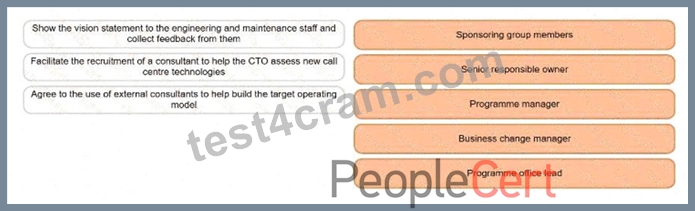
Answer:
Explanation: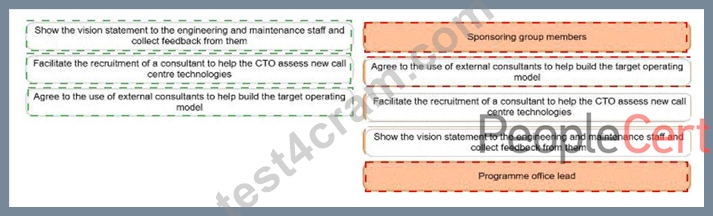
Explanation:
Design Action
Role
Show the vision statement to the engineering and maintenance staff and collect feedback from them Business change manager Facilitate the recruitment of a consultant to help the CTO assess new call centre technologies Programme manager Agree to the use of external consultants to help build the target operating model Senior responsible owner The BCM is responsible for the interface between the programme and the business (staff feedback). The Programme Manager handles the day-to-day operational facilitation and procurement support. The SRO has the ultimate authority to approve significant resource expenditures like external consultancies.
NEW QUESTION # 83
Which of the following is Not a core element of successful communication?
- A. Message Clarity and consistency
- B. Stakeholder identification and analysis
- C. Feedback Collection system
- D. Identifying correct people to communicate
Answer: D
Explanation:
While identifying the correct people to communicate with is important, MSP does not list it as one of the four core elements of successful communication.
The MSP Practitioner outlines the four core elements as:
a) Stakeholder identification and analysis
b) Message Clarity and consistency
c) Effective system of message delivery
d) Feedback Collection system
These elements ensure messages are targeted, clear, consistently delivered, and that feedback is captured to improve communication.
Misidentifying core communication elements can weaken engagement efforts, so focusing on these pillars supports stronger communication outcomes throughout the programme lifecycle.
NEW QUESTION # 84
Significant changes to the customer processes have been delivered and Tranche 2 is now complete. Many engineering staff do not believe that the Training Project is needed in Tranche 3 as they feel the changes to the new customer processes are minor. The programme manager is concerned that the engineering staff may have misunderstood the extent of the changes. As a result, the programme manager noted in the end-of-tranche report for Tranche 2, that there needs to be more engagement with engineering staff during subsequent tranches.
Is this recommendation an appropriate application of the 'evaluate new information' process, and why?
- A. Yes, because the end-of-tranche report should include a list of risks to the next tranche
- B. Yes, because the end-of-tranche report should report on the effectiveness of communications
- C. No, because the end-of-tranche report should focus on progress towards the target operating model
- D. No, because the end-of-tranche report should focus on the programme's financial performance
Answer: B
Explanation:
Comprehensive and Detailed 200 to 250 words of Explanation From Exact Extract of project- programme-and-portfolio-management of 5th Edition MSP:
The 'Evaluate new information' process involves more than just checking budgets; it requires an assessment of the programme's "soft" elements, such as stakeholder engagement and the effectiveness of communication.
The End-of-Tranche Report serves as a summary of the programme's health and readiness to proceed.
Option B is the correct answer. MSP 5th Edition emphasizes that for transformation to be successful, stakeholders must understand and accept the change. The fact that engineering staff view the changes as
"minor" suggests a failure in the communication strategy or a lack of understanding of the Vision. By noting this in the end-of-tranche report, the Programme Manager is correctly identifying a weakness in the Knowledge Theme (specifically stakeholder communication) that occurred during Tranche 2. Evaluating the effectiveness of how information was shared and received is a key part of this process. This allows the programme to adjust its Stakeholder Engagement Approach for Tranche 3, ensuring that the engineering staff are properly prepared for the upcoming Training Project. Without this evaluation, the programme would risk low engagement and poor benefit realization in the next tranche. The report is the formal mechanism for capturing these "lessons learned" and turning them into actionable governance decisions for the future.
NEW QUESTION # 85
Which of the following defines Dis-benefit?
- A. Measurable decline resulting from outcome perceived as negative
- B. Measurable improvement resulting from outcome perceived as an advantage
- C. Unplanned scenario that has happened and needs management intervention to reduce negative impact
- D. A scenario that may bring profit or loss to programme
Answer: A
Explanation:
A dis-benefit is defined as a measurable decline resulting from an outcome perceived as negative. The MSP Practitioner clearly states: "Measurable decline resulting from outcome perceived as negative defines mis- benefit," highlighting the need to manage and mitigate dis-benefits as part of benefits management to ensure overall programme success.
NEW QUESTION # 86
For a programme that focuses on Political and societal change which scenario will lead to lower probability of success?
- A. Long term societal effects
- B. New legislation reacting to societal trends
- C. Changes to public service delivery model
- D. Change to current legislation
Answer: A
NEW QUESTION # 87
POTI model is part of which governance theme?
- A. Blueprint
- B. Business Case
- C. Vision
- D. Risk and issue management
Answer: A
Explanation:
The POTI (Projects, Operations, Teams, and Infrastructure) model is part of the Blueprint governance theme.
It defines the high-level scope and structure of the blueprint, outlining how projects, operational activities, teams, and infrastructure work together to deliver transformation.
The MSP Practitioner confirms: "POTI model defines scope blueprint," situating it firmly within the Blueprint theme that describes the future state and the means to achieve it.
Understanding POTI helps in mapping and managing the components necessary for successful delivery of programme benefits within the defined future organizational state.
NEW QUESTION # 88
Which of the following defines an Emergent programme?
- A. Translation of political priorities into a programme to refine and deliver desired changes
- B. Programme focused on transforming the way business functions
- C. Evolved from concurrent, individual projects with need to ensure compliance to organization strategy
- D. Must do programmes often due to result of an external event and aimed to avoid negative implications
Answer: C
Explanation:
An Emergent programme is characterized by its evolution from a set of concurrent, individual projects that arise independently but require coordination to ensure they align with organizational strategy. The MSP Practitioner defines Emergent programmes as: "Programmes evolved from concurrent, individual projects with need to ensure compliance to organization strategy." This reflects programmes that may not have been planned from the start as a programme but are brought together to align with strategic goals and provide greater control and coherence.
NEW QUESTION # 89
Which of the following statements is NOT TRUE?
- A. The SRO is accountable for the Programme Brief.
- B. The SRO is accountable for confirming Programme Mandate.
- C. The Programme Manager is responsible for the Blueprint.
- D. The Programme Manager is responsible for the Vision Statement.
Answer: B
NEW QUESTION # 90
Which of following is NOT part of delivering the capability?
- A. Align projects with benefits realization
- B. Gateway reviews
- C. Governance: Manage and control delivery
- D. Start Projects
Answer: B
Explanation:
Gateway reviews are not part of delivering the capability but are governance checkpoints that occur at specific programme milestones, including the beginning of the programme, key decision points, and closure.
The MSP Practitioner explains: "Gateway reviews happen at beginning of programme, Key decision points of programme and closure of programme." These reviews are formal assessments to validate readiness, progress, and compliance with governance before major transitions, tranche approvals, or programme closure.
Delivering the capability primarily involves initiating projects, managing their delivery under governance frameworks, and ensuring alignment between project outputs and benefit realization. Governance during delivery includes managing risks, issues, and quality controls to ensure outputs are produced to specification.
Gateway reviews are designed to provide independent assurance and decision points but are external to the ongoing activities of capability delivery. Recognizing this distinction helps maintain clarity of roles and processes within programme management, ensuring focused effort on delivery while maintaining appropriate oversight.
NEW QUESTION # 91
......
Peoplecert MSP-Practitioner Exam Syllabus Topics:
| Topic | Details |
|---|---|
| Topic 1 |
|
| Topic 2 |
|
| Topic 3 |
|
| Topic 4 |
|
| Topic 5 |
|
Test Engine to Practice MSP-Practitioner Test Questions: https://pass4sure.test4cram.com/MSP-Practitioner_real-exam-dumps.html