Tight on time before your C_ADBTP exam? Test4Cram packs 10 focused practice questions for the SAP Administrating SAP Business Technology Platform(C_ADBTP_2601) exam into one download, so every study hour goes straight to what matters. Many candidates are exam-ready in weeks, not months.
SAP C_ADBTP Exam Syllabus Topics:
| Section | Weight | Objectives |
|---|---|---|
| SAP Discovery Center and Service Marketplace | <10 | - Find and provision services from the SAP BTP Service Marketplace - Navigate and utilize SAP Discovery Center for project guidance |
| DevOps | 11-20 | - Configure and operate CI/CD pipelines for SAP BTP applications - Implement monitoring and alerting for applications and services - Manage the application lifecycle using SAP BTP services |
| Security | 11-20 | - Manage platform-level security settings and policies - Implement audit logging and security monitoring - Configure and maintain identity and access management (IAM) for SAP BTP |
| SAP BTP Services | 11-20 | - Monitor service health and usage - Integrate services with other SAP and third-party systems - Provision and manage SAP BTP platform services |
| Connectivity | 11-20 | - Set up and manage connectivity between SAP BTP and on-premise systems - Configure and troubleshoot Cloud Connector and Destination configurations - Manage SAP BTP networking and tunneling services |
| SAP Business Application Studio / Visual Studio Code | <10 | - Integrate Visual Studio Code with SAP BTP for local development - Configure and use development environments in SAP Business Application Studio |
| SAP BTP Account and Subaccount Management | 11-20 | - Manage entitlements, quotas, and runtime environments - Implement directory and environment management - Create and configure global accounts and subaccounts |
SAP Administrating SAP Business Technology Platform(C_ADBTP_2601) Exam FAQs and Straight Answers
The C_ADBTP exam, officially titled Administrating SAP Business Technology Platform(C_ADBTP_2601), is the qualifying test for the SAP Certified Associate certification from SAP, a credential at the Associate level. Passing it proves you have the skills employers look for in certified professionals, and it can also support progress toward related credentials such as SAP Certified Associate – Administrator – SAP Business Technology Platform.
The SAP Administrating SAP Business Technology Platform(C_ADBTP_2601) exam gives you 180 minutes to work through 80 questions. That is a steady pace with little room for second-guessing, so train yourself to read each question once, flag the difficult ones, and keep moving. Before exam day, sit at least two full timed sessions in the Test4Cram test engine — when the clock feels familiar, it stops being a threat.
You need 63% to pass, and the official registration fee is USD 536. Fall short and you pay that fee in full again for every retake, which makes solid preparation the cheaper option by far. Work through the Test4Cram practice questions until you score comfortably above the passing mark, then book your seat.
None Eligibility rules can change over time, so before you register, confirm the latest requirements on the official exam page: SAP C_ADBTP exam overview.
Yes. Test4Cram offers a free PDF demo for the SAP Administrating SAP Business Technology Platform(C_ADBTP_2601) exam so you can judge the quality of our questions and answers before paying anything. Every purchase also comes with 365 days of free updates, and once that period expires you can extend your update service at a 50% discount.
Your purchase is protected by a 100% money-back guarantee. If you sit the corresponding C_ADBTP exam within 60 days of buying and do not pass, send us a scan of your exam enrollment slip together with your official Score Report (PDF) within 2 days of the exam date — the candidate name must match the payer's name — and we will process your full refund within 7 days. Please note that exams taken within 3 days of purchase, materials downloaded without ever sitting the exam, free products, and expired orders are not covered. If you would rather not have a refund, you can exchange your order for two exam products of equal value, free of charge, and keep the update service on your original purchase.
Delivery is instant: your files are emailed to you within one minute of payment and can also be downloaded directly, with no limit on the number of computers you install them on. If nothing has arrived within 2 hours, contact our customer service team and we will sort it out.
The SAP Administrating SAP Business Technology Platform(C_ADBTP_2601) syllabus is organized into 7 domains. The main areas include SAP Business Application Studio / Visual Studio Code (<10), SAP BTP Services (11-20), and Security (11-20). Scroll up to the Exam Topics section above for the complete, current outline before you plan your study schedule.
SAP Administrating SAP Business Technology Platform(C_ADBTP_2601) Sample Questions:
SIMULATION
Enable a Cloud Foundry Environment
Task 2: Enable and Configure a Cloud Foundry Environment
In your SAP BTP cockpit, in the EU HCM Dev subaccount, enable the Cloud Foundry environment in the cf-eu10-004 landscape. Set the instance name to cf-eu-hcm-dev and the org name to btpops####-eu-hcm-dev.
In the EU HCM Dev subaccount, create a space with the name activity-recording.
In the EU HCM Dev subaccount, create a space quota with the name half-org-quot a. Halve the available org quota for memory, routes, service, and instance memory for an unlimited number of app instances. Assign the space quota to activity-recording.
Correct Answer:
See the Explanation below for complete solution.
Explanation:
Before you start
Log in to SAP BTP Cockpit.
Open the correct Global Account.
Go to Directories.
Open Human Resources.
Open the EU HCM Dev subaccount.
This matters because the task must be completed specifically in EU HCM Dev. SAP documents that Cloud Foundry is enabled at subaccount level, and the system creates a Cloud Foundry org linked to that subaccount.
Part 1 - Enable the Cloud Foundry environment
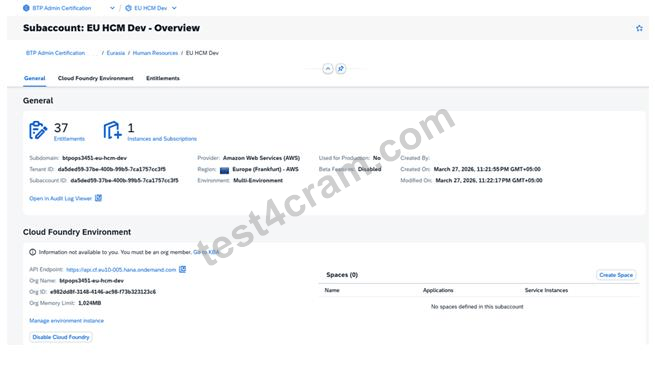
Step 1 - Open the subaccount overview
In EU HCM Dev, go to Overview.
Explanation:
SAP Help describes the cockpit flow for enabling Cloud Foundry from the subaccount Overview page.
What to verify
You should see a Cloud Foundry section on the overview page.
Step 2 - Start enabling Cloud Foundry
In the Cloud Foundry section, click Enable Cloud Foundry.
Explanation:
This starts creation of the Cloud Foundry organization for the subaccount. SAP notes that when you enable Cloud Foundry in a subaccount, the system automatically creates a Cloud Foundry org for it.
Step 3 - Enter the required Cloud Foundry values
In the enablement dialog, enter:
Landscape: cf-eu10-004
Instance Name: cf-eu-hcm-dev
Org Name: btpops####-eu-hcm-dev
Then confirm by clicking Create or Enable.
Explanation:
The task gives you the exact landscape and naming values to use. SAP documentation shows that enabling Cloud Foundry in the cockpit requires naming the Cloud Foundry instance and org.
What to verify
After the process completes, the subaccount should show Cloud Foundry as enabled, with the org created for EU HCM Dev.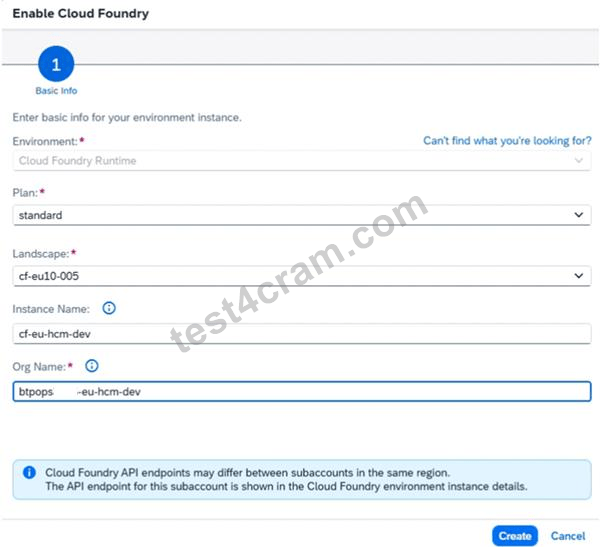
Part 2 - Create the space
Step 4 - Open Spaces
In EU HCM Dev, after Cloud Foundry is enabled, open:
Cloud Foundry
Spaces
Explanation:
SAP Help shows that spaces are created from the Spaces area after Cloud Foundry is enabled in the subaccount.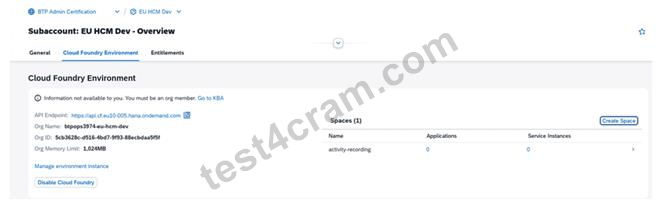
Step 5 - Create the space
Click Create Space.
Enter:
Space Name: activity-recording
Confirm by clicking Create.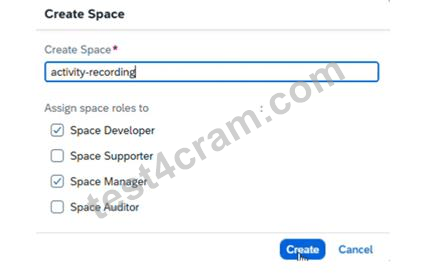
Explanation:
This creates the required Cloud Foundry space inside the org for EU HCM Dev. SAP's cockpit documentation and setup guides show this as the standard next step after enabling the environment.
What to verify
You should now see:
activity-recording
in the list of Cloud Foundry spaces.
Part 3 - Create the space quota
Step 6 - Open Cloud Foundry Space Quotas
In EU HCM Dev, open:
Cloud Foundry
Space Quotas
Explanation:
SAP Help states that, in the Cloud Foundry environment, the quotas allocated to a subaccount can be further distributed by creating space quota plans, and these are managed from the Cloud Foundry Space Quotas area.
Step 7 - Create a new space quota
Click Create Space Quota or New Space Quota.
Enter the quota name:
half-org-quota
Explanation:
This creates a quota plan that you will assign to the required space. SAP Help describes creating space quota plans in the subaccount and then assigning them to spaces.
Step 8 - Set quota values to half of the org quota
In the quota form, set the values to half of the available org quota for:
Memory
Routes
Services
Instance Memory
For App Instances, set:
Unlimited
Then save the quota.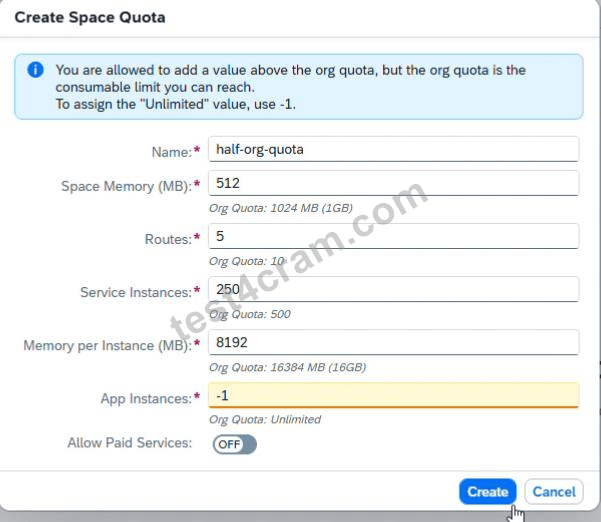
Explanation:
The simulation asks you to halve the available org quota for those four dimensions. SAP Help confirms that space quotas are used to limit resource consumption inside the org by defining values such as memory, routes, and service instances, and that these plans can then be assigned to spaces.
How to calculate "half"
Use the current org quota values shown in the Cloud Foundry quota screens and divide each by 2 before entering it.
Examples:
If org memory = 2 GB, enter 1 GB
If routes = 20, enter 10
If services = 200, enter 100
If instance memory = 2 GB, enter 1 GB
What to verify
The new quota plan should exist as:
half-org-quota
with the reduced values saved.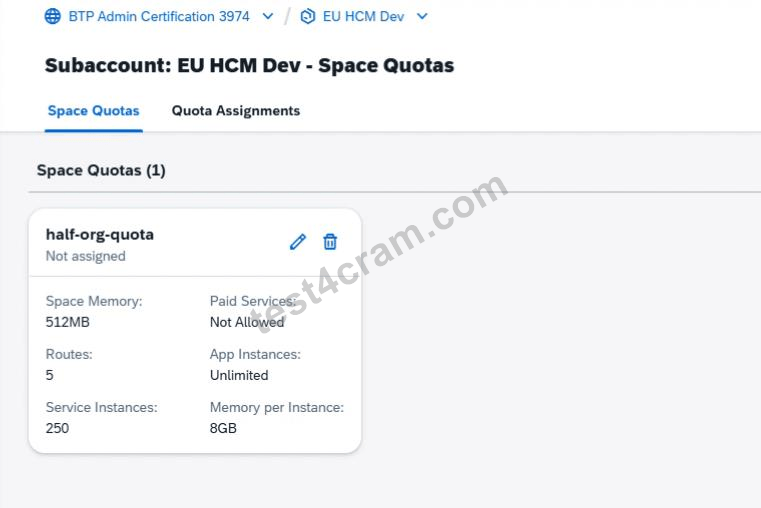
Part 4 - Assign the quota to the space
Step 9 - Assign the quota to activity-recording
Open the newly created quota:
half-org-quota
Choose Assign Spaces or Assign to Spaces
Select:
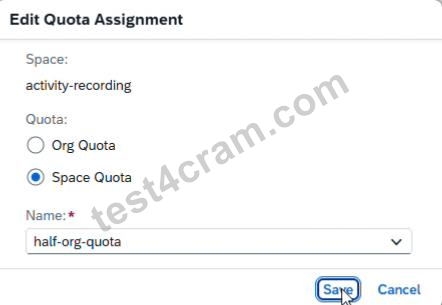
activity-recording
Save the assignment
Explanation:
SAP Help states that after creating a space quota, you assign it to one or more spaces from the space quota management flow.
What to verify
The quota half-org-quota should now be assigned to:
activity-recording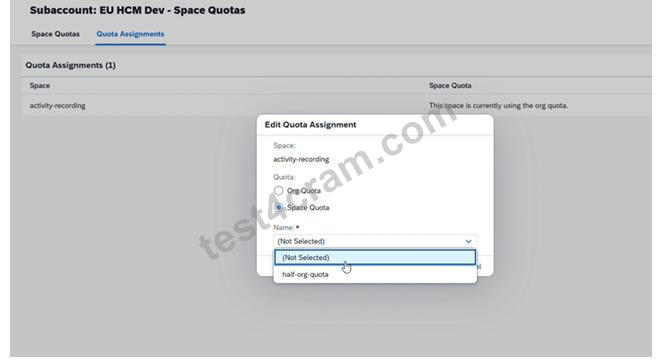
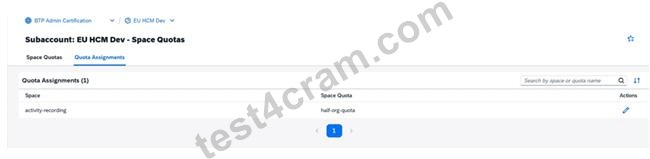
Final expected result
Inside EU HCM Dev:
Cloud Foundry is enabled
landscape is cf-eu10-004
instance name is cf-eu-hcm-dev
org name is btpops####-eu-hcm-dev
space activity-recording exists
space quota half-org-quota exists
memory, routes, services, and instance memory are each set to half of the available org quota app instances are unlimited quota half-org-quota is assigned to activity-recording Common mistakes to avoid Enabling Cloud Foundry in the wrong subaccount; it must be EU HCM Dev.
Using the wrong landscape; the task explicitly requires cf-eu10-004.
Typing the wrong org name; use exactly btpops####-eu-hcm-dev.
Forgetting to create the space before assigning the quota.
Entering full org quota instead of half.
Limiting app instances to a number instead of leaving them unlimited.
Creating the quota but not assigning it to activity-recording.
Viewing page 1 out of 10 pages.
Viewing questions 1-1 out of 10 questions.