Preparation without limitation: the SAP Administrating SAP Business Technology Platform(C_ADBTP_2601) online engine from Test4Cram works on any electronic equipment, no cap on installed devices — 10 practice questions for the C_ADBTP exam, anytime.
SAP C_ADBTP Exam Syllabus Topics:
| Section | Weight | Objectives |
|---|---|---|
| Topic 1: DevOps & Lifecycle Management | 10% | - CI/CD and automation tools - Transport management |
| Topic 2: Platform Connectivity & Integration | 20% | - Destinations and connectivity services - Cloud Connector setup and operation |
| Topic 3: Operations, Monitoring & Observability | 15% | - SAP Cloud ALM integration - Logging, metrics and alerting |
| Topic 4: SAP BTP Architecture & Account Management | 20% | - Global account, directory, subaccount structure
|
| Topic 5: Security & Identity Management | 25% | - SAP Cloud Identity Services
|
| Topic 6: Governance, Cost & Consumption | 10% | - Compliance and policy management - Quota and usage monitoring |
C_ADBTP Exam Questions Answered
Delivery is instant: payment triggers an automatic email within a minute — unlimited installations, and 24/7 customer assisting for any downloading or purchasing issue if nothing arrives within 2 hours. If you fail the corresponding C_ADBTP exam within 60 days of purchase, choose your remedy: a full refund (scanned enrollment slip plus the official Score Report PDF within 2 days of the exam; processed within 7 days), waiting for the next updated version free, or a free change to two other equal-value dumps. Excluded: exams within 3 days of purchase, candidate names that don't match the payer, and free or expired products.
120 minutes for 40–50 questions. Fit the atmosphere in advance: timed sessions in the Test4Cram online engine make the formal pace feel practiced, not pressured.
Use the vendor's official registration channels:
The SAP Administrating SAP Business Technology Platform(C_ADBTP_2601) is delivered Online proctored or onsite at authorized test centers — select whichever arrangement suits you when booking.
The SAP Administrating SAP Business Technology Platform(C_ADBTP_2601) blueprint spans 6 domains — including Security & Identity Management (25%), SAP BTP Architecture & Account Management (20%), Platform Connectivity & Integration (20%). Let the weightings direct your spare-time review; the full outline above lists every subtopic.
Can I try the SAP Administrating SAP Business Technology Platform(C_ADBTP_2601) material free first?
Yes — download the free SAP Administrating SAP Business Technology Platform(C_ADBTP_2601) demo and evaluate the material before paying. Purchases include 365 days of free updates, each new version emailed immediately upon release; renew afterward at 50% off.
Basic knowledge of cloud concepts and SAP BTP; no mandatory prerequisites Eligibility rules change periodically, so confirm the current requirements on the official page (official C_ADBTP exam page) before registering.
Yes:
Courses give you the theory; the 10 practice questions for the SAP Administrating SAP Business Technology Platform(C_ADBTP_2601) give you the rehearsal — every answer expert-verified.
The SAP Administrating SAP Business Technology Platform(C_ADBTP_2601) is SAP's certification exam for SAP Certified Associate - SAP BTP Administrator, at the Associate level. It validates job-ready skills, and passing it marks you as a verified professional. Related credentials include SAP Certified Associate - SAP BTP Extension Developer, SAP Certified Specialist - SAP BTP Operations.
$578 USD per attempt, 65% to pass. A retake costs the full fee again — effective preparation with the 10 practice questions for the C_ADBTP exam is the economical path.
SAP Administrating SAP Business Technology Platform(C_ADBTP_2601) Sample Questions:
SIMULATION
Establish Shared Services
Task 1: Create a Shared Services Directory and Subaccounts
In your SAP BTP cockpit, create the directory Shared Services (Description: Shared Accounts) with your global account as the parent.
In the Shared Services directory, create the subaccount SH Dev (Description: Shared Services Development) with subdomain btpops####-sh-dev in the region Amazon Web Services (AWS) → Europe (Frankfurt) cf-eu10.
In the Shared Services directory, create the subaccount SH Ops (Description: Shared Services Operations) with subdomain btpops####-sh-ops in the region Amazon Web Services (AWS) → Europe (Frankfurt) cf-eu10.
Correct Answer:
See the Explanation below for complete solution.
Explanation:
Before You Start
Log in to the SAP BTP Cockpit.
Open the correct Global Account.
Make sure you are working in the correct global account before creating anything.
Why this matters:
The new directory and both subaccounts must be created inside the correct global account hierarchy.
Part A - Create the Shared Services Directory
Step 1 - Open Directories
What to do
In the SAP BTP Cockpit, open your Global Account.
In the left navigation menu, click Directories.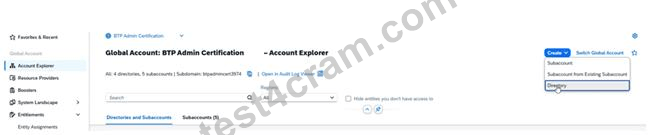
Explanation:
This is where you create and manage directory structures under the global account.
What to verify
You should now see the list of existing directories.
Step 2 - Create the Directory Shared Services
What to do
Click Create or Create Directory.
Enter the following values:
Name: Shared Services
Description: Shared Accounts
Parent: your Global Account
Click Create.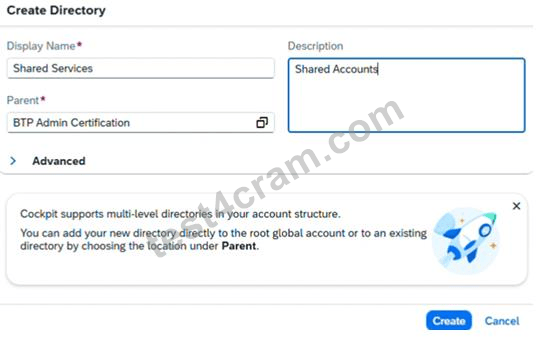
Explanation:
This creates a new top-level directory directly under the global account.
It will be used to hold the shared-services subaccounts.
What to verify
You should now see:
Shared Services
under the global account.
Part B - Create the SH Dev Subaccount
Step 3 - Open the Shared Services Directory
What to do
In the directory list, select Shared Services.
Explanation:
Both required subaccounts must be created inside this directory.
What to verify
You should now be inside the Shared Services directory.
Step 4 - Open Subaccounts
What to do
Inside Shared Services, open Subaccounts.
Click Create → Subaccount.
Explanation:
This opens the subaccount creation screen.
Step 5 - Create SH Dev
What to do
Enter the following:
Display Name / Name: SH Dev
Description: Shared Services Development
Subdomain: btpops####-sh-dev
Set the region as:
Cloud Provider: Amazon Web Services (AWS)
Region: Europe (Frankfurt)
Technical Region / Environment: cf-eu10
Then click Create.
Explanation:
This creates the shared services development subaccount in the required AWS Frankfurt region.
What to verify
After creation, you should see:
SH Dev
inside the Shared Services directory.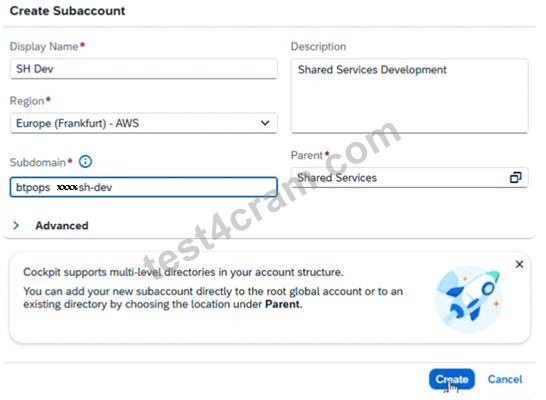
Part C - Create the SH Ops Subaccount
Step 6 - Start a New Subaccount
What to do
Still inside Shared Services, click Create → Subaccount again.
Explanation:
This opens the form for the second required subaccount.
Step 7 - Create SH Ops
What to do
Enter the following:
Display Name / Name: SH Ops
Description: Shared Services Operations
Subdomain: btpops####-sh-ops
Set the region as:
Cloud Provider: Amazon Web Services (AWS)
Region: Europe (Frankfurt)
Technical Region / Environment: cf-eu10
Then click Create.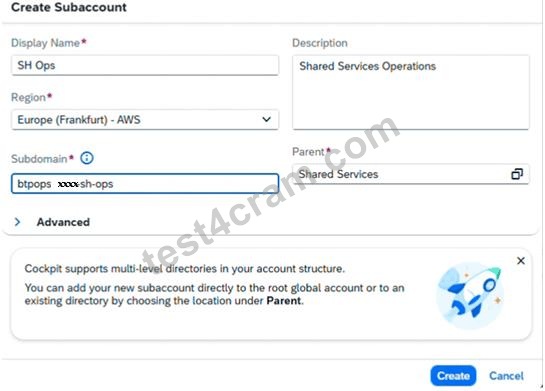
Explanation:
This creates the shared services operations subaccount in the same required region.
What to verify
After creation, you should see:
SH Ops
inside the Shared Services directory.
Final Expected Result for Task 1
You should now have:
Directory
Shared Services
Description: Shared Accounts
Parent: Global Account
Subaccounts inside Shared Services
SH Dev
Description: Shared Services Development
Subdomain: btpops####-sh-dev
Region: AWS → Europe (Frankfurt) cf-eu10
SH Ops
Description: Shared Services Operations
Subdomain: btpops####-sh-ops
Region: AWS → Europe (Frankfurt) cf-eu10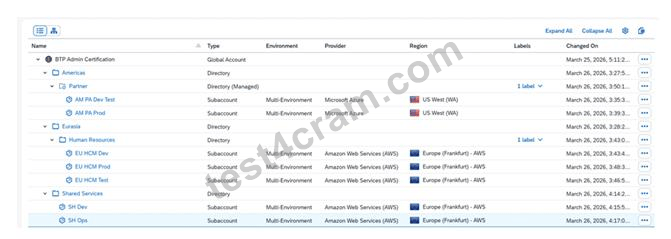
Common Mistakes to Avoid
1. Creating the directory in the wrong place
Shared Services must be created with:
parent = Global Account
2. Creating the subaccounts outside the directory
Both subaccounts must be created inside:
Shared Services
3. Wrong subdomain values
Use exactly:
btpops####-sh-dev
btpops####-sh-ops
Only replace #### with your global account number.
4. Wrong region
Both subaccounts must use:
Amazon Web Services (AWS)
Europe (Frankfurt)
cf-eu10
5. Mixing up SH Dev and SH Ops
Be careful:
SH Dev = Shared Services Development
SH Ops = Shared Services Operations
Viewing page 1 out of 10 pages.
Viewing questions 1-1 out of 10 questions.